Energy · Minerals · How-To
Iron and magnesium are two of the minerals your cells lean on every day for energy. Iron helps carry oxygen to your tissues, and magnesium helps your cells turn food into usable energy.* So it is no surprise that many people take both, and that one of the most common questions we hear is whether they can go down together.
The short answer: yes, you can take iron and magnesium on the same day, but most people do best taking them a couple of hours apart. Here is why, what the research does and does not show, and a simple daily schedule that keeps both working for you.
Take iron in the morning, then wait about two hours before your magnesium. Spacing minerals apart is a simple habit that keeps them from competing in your stomach at the same time, and it costs you nothing.
Why Iron and Magnesium Both Matter for Cellular Energy
These two minerals do very different jobs, which is why one cannot stand in for the other.
- Iron is part of hemoglobin, the protein in red blood cells that carries oxygen from your lungs to your tissues. It is also part of myoglobin, which supplies oxygen to your muscles, and it is needed for normal cell function and growth.1
- Magnesium is a cofactor for more than 300 enzyme systems, including the ones your cells use for energy production. It also supports normal muscle and nerve function and helps build bone.*2
Put simply, iron helps deliver the oxygen, and magnesium helps your cells use it to make energy.* When you are short on either one, you may notice it in your energy first.
Does Magnesium Block Iron Absorption?
This is the heart of the question, and the honest answer is that the research is limited and mixed. Most of it looks at magnesium antacids taken in large amounts, not at the daily magnesium most people use.
In a randomized crossover study of 13 healthy men, a large dose of magnesium hydroxide (an antacid) taken one hour after iron lowered the amount of iron absorbed over the next 12 hours.3 A second randomized study of 16 healthy men, using a smaller ratio of magnesium hydroxide to iron, found no difference in iron levels.4 An older report found that magnesium trisilicate, another antacid, reduced iron absorption.5
Why would an antacid matter? Iron, especially the iron in plants and most supplements, is absorbed best when there is enough stomach acid. Antacids are designed to neutralize that acid. Medicines that lower stomach acid, such as proton pump inhibitors, are also known to reduce how much of this kind of iron you absorb.1
We are not aware of a study that tests everyday magnesium amounts, such as a glass of magnesium water, against iron absorption. That gap is exactly why spacing them is the sensible default. It is easy, it removes the question entirely, and it matches the advice experts already give for iron and calcium, which may also compete for absorption.1
How to Time Iron and Magnesium
A simple schedule works for most people. If your healthcare provider has given you a specific iron plan, follow it, and use this as a guide for fitting magnesium around it.
| When | What | Why |
|---|---|---|
| Morning | Iron, with water or a vitamin C food such as orange slices or berries | Vitamin C helps your body absorb the iron in plants and most supplements.1 |
| At least 2 hours later | Magnesium, and any calcium or multi-mineral | Keeps the minerals from meeting in your stomach at the same time. |
| Evening | More magnesium, if it is part of your routine | Many people like magnesium later in the day as part of winding down. |
Why Mornings Work for Iron
Researchers in Switzerland used labeled iron to measure absorption in women with low iron stores. Single morning doses were absorbed as well as the same amount split into two doses, and taking iron every other day led to higher total absorption than taking it every day.6 The same group later noted that a second dose in the afternoon or evening is absorbed less well.7 These findings apply to iron supplements prescribed for low iron, so talk with your provider before you change how often you take yours.
What About Magnesium Glycinate?
We get this question a lot. The timing advice is the same for every form of magnesium, whether it is glycinate, citrate, oxide, or chloride. The form affects how your body tolerates and uses magnesium, but spacing it about two hours from iron is the simple rule either way. For a closer look at the forms, see 5 Different Types of Magnesium.
Other Things to Keep Away From Your Iron
- Calcium: may reduce iron absorption, so many experts suggest taking calcium and iron at different times of day.1
- Antacids and acid-lowering medicines: less stomach acid means less of this kind of iron is absorbed.1
- Whole grains, beans, and some plant compounds: phytates and certain polyphenols can reduce absorption when eaten at the same time as iron.1
- Some prescription medicines: iron can interfere with certain thyroid and other medicines, so ask your pharmacist how far apart to take them.1
One more note: with iron, more is not better. The upper limit for adults is 45 mg a day from food and supplements, and higher amounts can upset your stomach.1 Take only what your provider suggests.
Food First: Where to Find Both Minerals
Food is the best foundation for both minerals, and a few foods carry a good amount of each.
- Pumpkin seeds: one of the richest magnesium foods (about 156 mg per ounce), with iron too.2
- Spinach and other leafy greens: about 78 mg of magnesium per half cup cooked, plus plant iron.2
- Beans and lentils: black beans add about 60 mg of magnesium per half cup, and beans are a staple plant source of iron.2
- Cashews and almonds: about 74 to 80 mg of magnesium per ounce.2
- Meat, poultry, and seafood: provide the form of iron the body absorbs most easily, and they also help you absorb the iron in plant foods eaten at the same meal.1
Tip: pair plant iron with a vitamin C food, such as peppers, citrus, or strawberries, to help your body absorb more of it.1
Where ReMag® Fits in Your Day
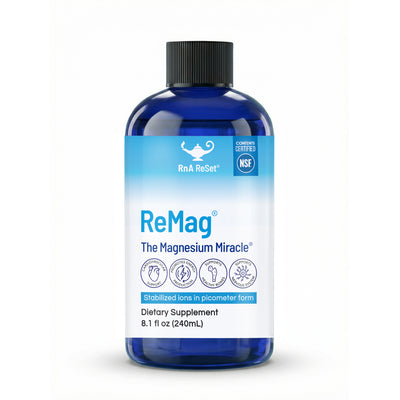
If you use a liquid magnesium, timing is easy to manage. ReMag® is a picometer-size magnesium that you mix into a liter of water and sip through the day, so you control when it starts.* On iron days, simply begin your ReMag® water a couple of hours after your iron. Magnesium supports cellular energy production, normal muscle function, and nerve function.*
RnA ReSet formulas do not contain iron. If you also use ReMyte®, which includes calcium among its 12 minerals, handle it the same way and keep it a couple of hours from your iron.
- You can take iron and magnesium on the same day. Most people do best taking them about two hours apart.
- The studies showing magnesium lowering iron absorption used large doses of magnesium antacids, not everyday magnesium.
- Take iron in the morning with a vitamin C food, and keep calcium, antacids, and multi-minerals away from it.
- Magnesium supports the energy production inside your cells, and iron helps deliver the oxygen they use.*
Frequently Asked Questions
Can I take iron and magnesium glycinate together?
The timing advice is the same for any form of magnesium, including glycinate, citrate, and chloride. Take iron first, ideally in the morning, and wait about two hours before your magnesium.
How long after taking iron can I take magnesium?
About two hours is a simple, practical gap. It keeps the two out of your stomach at the same time, which is the main reason people separate minerals.
Can I take iron at night with magnesium?
Most people do better taking iron in the morning and magnesium later in the day. Research in women with low iron stores found that morning doses were absorbed well, and many people already like magnesium in the evening.
Does magnesium help with low iron?
No. Magnesium and iron do different jobs, and magnesium does not raise iron levels. If you think your iron is low, ask your healthcare provider about a blood test before you start an iron supplement.
Does magnesium have iron in it?
No. Magnesium and iron are two separate minerals. A magnesium supplement contains magnesium bound to another compound, such as chloride or glycinate, and no iron unless the label lists it.
Is it OK to take iron and magnesium on the same day?
Yes. Taking both on the same day is common. The simple habit is to take them at different times of day rather than in the same glass or handful.
References: 1. National Institutes of Health, Office of Dietary Supplements. Iron: Fact Sheet for Health Professionals. ods.od.nih.gov/factsheets/Iron-HealthProfessional 2. National Institutes of Health, Office of Dietary Supplements. Magnesium: Fact Sheet for Health Professionals. ods.od.nih.gov/factsheets/Magnesium-HealthProfessional 3. Wallace KL, Curry SC, LoVecchio F, Raschke RA. Effect of magnesium hydroxide on iron absorption following simulated mild iron overdose in human subjects. Acad Emerg Med. 1998;5(10):961-965. doi:10.1111/j.1553-2712.1998.tb02771.x 4. Snyder BK, Clark RF. Effect of magnesium hydroxide administration on iron absorption after a supratherapeutic dose of ferrous sulfate in human volunteers: a randomized controlled trial. Ann Emerg Med. 1999;33(4):400-405. doi:10.1016/s0196-0644(99)70303-3 5. Hall GJ, Davis AE. Inhibition of iron absorption by magnesium trisilicate. Med J Aust. 1969;2(2):95-96. doi:10.5694/j.1326-5377.1969.tb105628.x 6. Stoffel NU, Cercamondi CI, Brittenham G, et al. Iron absorption from oral iron supplements given on consecutive versus alternate days and as single morning doses versus twice-daily split dosing in iron-depleted women. Lancet Haematol. 2017;4(11):e524-e533. doi:10.1016/S2352-3026(17)30182-5 7. Stoffel NU, von Siebenthal HK, Moretti D, Zimmermann MB. Oral iron supplementation in iron-deficient women: how much and how often? Mol Aspects Med. 2020;75:100865. doi:10.1016/j.mam.2020.100865
*These statements have not been evaluated by the Food and Drug Administration. This product is not intended to diagnose, treat, cure, or prevent any disease. This article is for educational purposes and is not a substitute for advice from your healthcare provider.